Köpa.se Logo
x
569 056
PRODUKTER
x
1 542
KATEGORIER
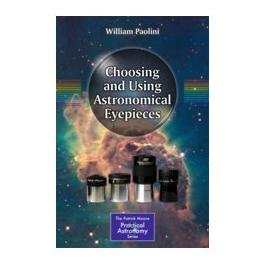
Choosing And Using Astronomical Eyepieces

Denna bok är en värdefull resurs för alla som är intresserade av astronomiska okular. Den fungerar som en köpguide, fältguide och teknisk referens. Boken dokumenterar marknaden för okular från det förflutna fram till idag.

459 kr

Böcker
Pysselböcker
AstroSwedenKöp produkten hos AstroSweden
Liknande produkter
Scientific Astrophotography
459 kr
AstroSweden
How Amateurs Can Generate and Use Professional Imaging Data Scientific Astrophotography is a work for those amateur astronomers looking for new challenges, once they have mastered visual observing and the basic imaging of various astronomical objects. It is a wonderful reference for scientifically-inclined observers who want to learn the fundamentals of astrophotography with a firm emphasis on the discipline of scientific imaging. Scientific Astrophotography, Author: Gerald R Hubbell This book is a wealth of information and a distillation of ideas presented by a diverse set of sources and based on the most recent techniques, equipment, and data available. It also includes numerous exercises for the reader, to maximize the success and minimize the frustration inherent in the pursuit of this specific craft. Scientific Astrophotography is perfect for any amateur astronomer who wants to go beyond just the process of making beautiful images and actually contribute to the science of astronomy! "...Gerald Hubbell's new book, Scientific Astrophotography, is the perfect companion for anyone dipping their toe into the digital imaging realm for the first time. The author answers all the questions people have when starting out, such as how do I get the most bang for my buck, and how do I select the right CCD for my telescope?" * Mike Simonsen, American Association of Variable Star Observers
Nebulae and How to Observe Them
295 kr
AstroSweden
Nebulae are the places where the stars are born. For amateur astronomers, the many different kinds of nebulae vary from "easy" targets that can be seen with modest equipment under mediocre skies, to more obscure "challenging" objects that require experienced observers, more powerful telescopes and excellent observation conditions.Nebulae and How to Observe Them, Authors: Coe, Steven The concept of this book - and of the series - is to present an up-to-date detailed description and categorisation of nebulae, and then to instruct the reader in the best ways to successfully observe and record the large range of astronomical objects that fall under the general heading of "nebulae". Nebulae and How to Observe Them is a comprehensive mine of information for all levels of amateur observers, from the beginner to the experienced. The Astronomers Observing Guides are designed for practical amateur astronomers who not only want to observe, but want to know the details of exactly what they are looking at ASTRONOMERS OBSERVING GUIDES provide up-to-date information for amateur astronomers who want to know all about what it is they are observing. This is the basis of the first part of the book. The second part details observing techniques for practical astronomers, working with a range of different instruments. Steven Coe 1st Edition., 2007, X, 156 p. 128 illus., 11 in color.
Remote Observatories for Amateur Astronomers
415 kr
AstroSweden
Using High-Powered Telescopes from Home * Tells amateur astronomers how anyone at home can access and use a professional telescope at a remote observatory. * Explains the technology behind the development of remote observatories, once only used by professionals but now available to amateur observers. * Includes practical information on how to choose a remote observatory, costs, and benefits, and presents many possible projects suitable to carry out with a remote observatory. Remote Observatories for Amateur Astronomers, Authors: Hubbell, Gerald R., Williams, Richard J., Billard, Linda M. Amateur astronomers who want to enhance their capabilities to contribute to science need look no farther than this guide to using remote observatories. The contributors cover how to build your own remote observatory as well as the existing infrastructure of commercial networks of remote observatories that are available to the amateur. They provide specific advice on which programs to use based on your project objectives and offer practical project suggestions. Remotely controlled observatories have many advantages—the most obvious that the observer does not have to be physically present to carry out observations. Such an observatory can also be used more fully because its time can be scheduled and usefully shared among several astronomers working on different observing projects. More and more professional-level observatories are open to use by amateurs in this way via the Internet, and more advanced amateur astronomers can even build their own remote observatories for sharing among members of a society or interest group.
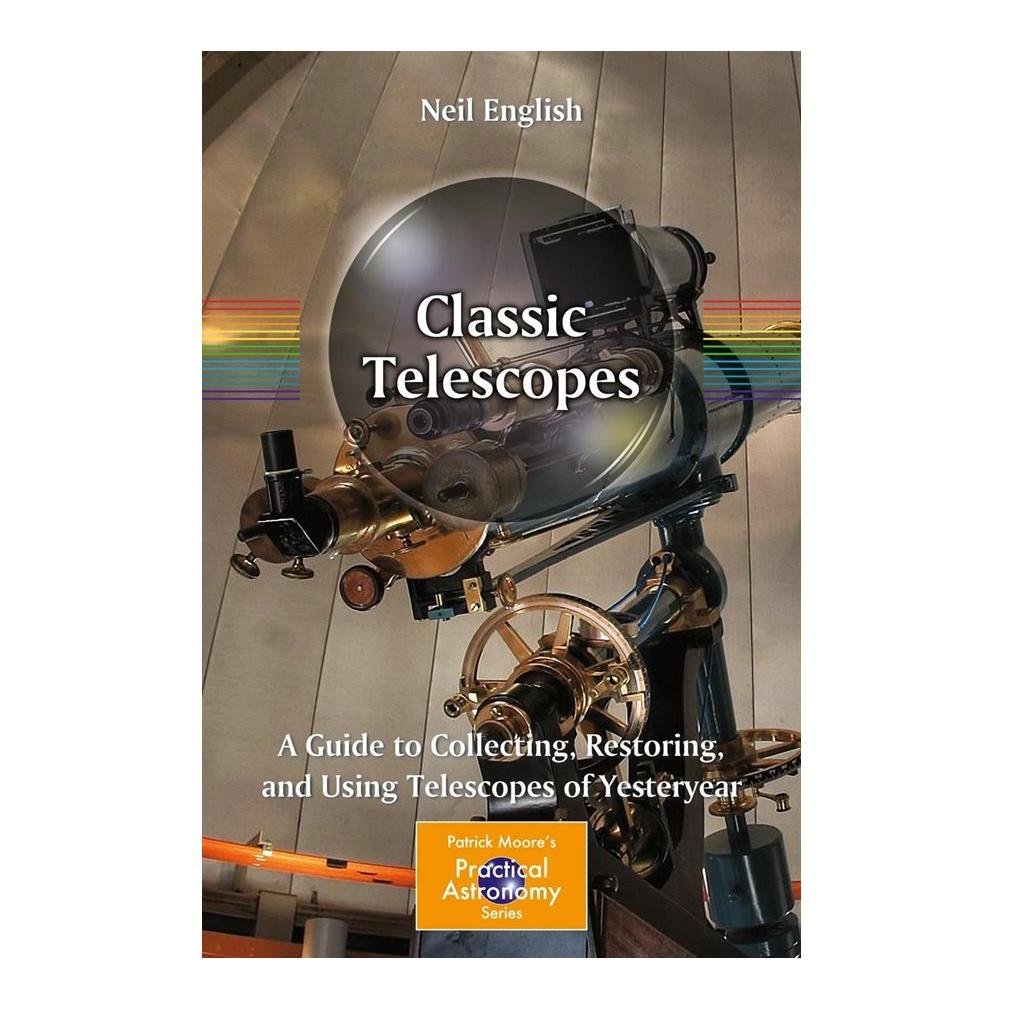
Classic Telescopes - A Guide to Collecting, Restoring, and Using Telescopes of Y
355 kr
AstroSweden
Includes some rare photos of the most iconic telescopes ever built, revealing their allure and making obvious the value of these wonderful instruments. Shows readers how to find real bargains on classic telescopes, especially using eBay and the rest of the Internet. Interviews top telescope collectors and users from both sides of the Atlantic. Includes review of some specific instruments that are often talked about on the amateur Internet forums Classic telescopes are of interest to amateur astronomers for a variety of reasons. There are the dedicated collectors, but there are also many amateurs who love the nostalgia they inspire. These telescopes "feel" different from any contemporary telescope and perhaps have a unique ability to reconnect the owner to a bygone age of craftmanship. This book takes a look at traditional telescopes built by the great instrument makers of the 18th and 19th centuries, particularly the dynastic telescope makers, including Dollond, Alvan Clark, Thomas Cooke & Sons, and Carl Zeiss. Also included are lesser luminaries such as John Brashear, John Calver, William Wray, Henry Fitz, and William Henry Mogey. 'Classic Telescopes' covers the key features of the telescopes designed by these manufacturers, and shows how a heady combination of market trends, instrument condition, and pedigree will dictate their prices at auction. 'Classic Telescopes' also shows the reader how to find real bargains! Interviews with top classic telescope collectors (and users) provide the best tips of prospecting for a genuine acquisition.
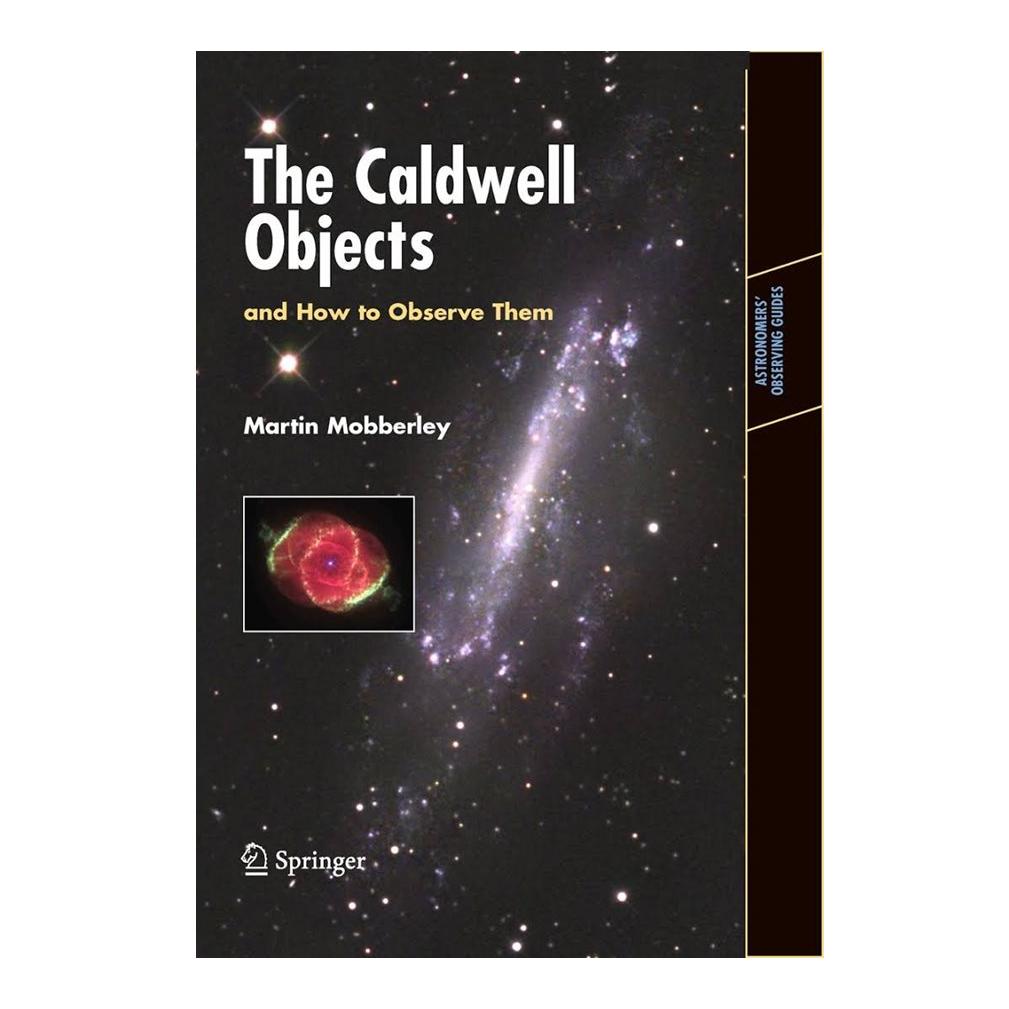
The Caldwell Objects and How to Observe Them
419 kr
AstroSweden
If you're wanting a challenge for your newly acquired telescope, or are interested in seeing what others have highlighted as some of the greatest sights in the night sky, this book will set you on the path of discovery.The Caldwell Objects and How to Observe Them There have been only a handful of famous deep sky "catalogs," including Charles Messier's, which was the first and remains the most famous. Messier was a comet hunter, and in the late 1700s he published a list of 109 objects in the sky that were not comets. In December 1995, Sky & Telescope published a list of deep sky objects sent to them by British amateur astronomer extraordinare, Sir Patrick Moore (officially, Sir Patrick Caldwell-Moore). It was a huge hit! Sir Patrick may be the most prolific authors of astronomy books for all time and has been presenting the BBC Sky at Night television series since April 1957. Moore's list contained 109 non-Messier objects that were Patrick's favorites, many of them visible only in the southern hemisphere. Accompanying the list of objects were long exposure black and white and color photographs of some of these objects. In this book Martin Mobberley, who has known Sir Patrick Moore for many years, describes these objects and tells how to locate them. He discusses the best ways to visually observe them and image them. He also tells a little of Moore's life and observing practices and how he made his choices for the "catalog." If you're wanting a challenge for your newly acquired telescope, or are interested in seeing what others have highlighted as some of the greatest sights in the night sky, this book will set you on the path of discovery.
Jupiter And How To Observe It
385 kr
AstroSweden
Jupiter is one of the most spectacular observing targets for amateur astronomers. There are various books about observing the planets, and several about Jupiter itself, but this is the only book to deal with the giant planet - its formation, structure, and incredible physics - as well as with the practical aspects of observation of the planet and its moons.Jupiter and how to observe it, Authors: McAnally, John W. The concept of the book - and of the series - is to present an up-to-date detailed physical and astrophysical description (part one) and then (part two) to consider how best to observe and image the giant planet. Jupiter and How to Observe It is a mine of information for all levels of amateur observers, from the beginning to the experienced, and will be fascinating reading for all practical amateur astronomers. 1st Edition., 2008, X, 218 p.
Observing the sun
355 kr
AstroSweden
A comprehensive solar observing guide for use at the telescope by amateur astronomers at all three levels: beginning, intermediate, and advanced. Users will find invaluable information for identifying features through photos, charts, diagrams in a logical, orderly fashion and then interpreting the observations.Observing the sun - A Pocket FieldGuide, Author: Jamey L. Jenkins Because the Sun is a dynamic celestial body in constant flux, astronomers rarely know for certain what awaits them at the eyepiece. All features of the Sun are transient and sometimes rather fleeting. Given the number of features and the complex life cycles of some solar features, it can be a challenging hobby, and this guide provides all of the guidance necessary to inform observers about the sights and events unfolding before their eyes on the most active and powerful member of our Solar System.
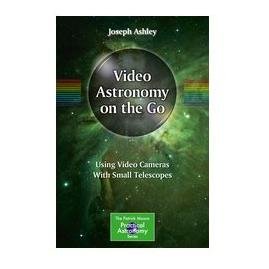
Video astronomy on the go
231 kr
AstroSweden
Utgiven: 2017Video astronomy on the go Author Joseph Ashley explains video astronomy's many benefits in this comprehensive reference guide for amateurs. Video astronomy offers a wonderful way to see objects in far greater detail than is possible through an eyepiece, and the ability to use the modern, entry-level video camera to image deep space objects is a wonderful development for urban astronomers in particular, as it helps sidestep the issue of light pollution. The author addresses both the positive attributes of these cameras for deep space imaging as well as the limitations, such as amp glow. The equipment needed for imaging as well as how it is configured is identified with hook-up diagrams and photographs. Imaging techniques are discussed together with image processing (stacking and image enhancement). Video astronomy has evolved to offer great results and great ease of use, and both novices and more experienced amateurs can use this book to find the set-up that works best for them. Flexible and portable, they open up a whole new way of seeing space.
Astronomy Adventures And Vacations
299 kr
AstroSweden
This astronomy travel guide examines the many wonderful opportunities for experiencing the observing hobby. Amateur astronomy is often consigned to observing from home or from a local park, yet it can be much more.Astronomy Adventures and Vacations, author: Timothy Treadwell Tim Treadwell explores all the possibilities of astronomical and space-related activities that are available on day trips and longer vacations. These activities range from observatory visits and other simple ways to build an astronomy event into a holiday, to full blown specialized astronomy travel. Many trips give the opportunity to visit some of the world's famous attractions. On most vacations it can be a matter of just taking a day (or night) out of your schedule to fit in an astronomy event, but larger, dedicated pilgrimages are also possible. How to make the most of astronomy potential on a holiday, whether observing on the beach in Hawaii with the Telescope Guy or visiting Star City in Russia, is covered in detail. Go to a star party, explore the national parks or see the northern lights! There are a wide variety of activities for all budgets described in this book.
Koppartråd - 1,0 mm, 1 kg
570 kr
AstroSweden
Koppartråd på rulle. Diameter: 1,00 mm Vikt: 1 kg Längd: 140 meter Tråden kan användas till MG36b - Magnettåget
Deep Sky Guide Desk Edition
1295 kr
AstroSweden
The Interstellarum Deep Sky Atlas set a new high standard for modern celestial cartography. The same team now presents the Interstellarum Deep Sky Guide, its unique observing companion. Taking an intuitive visual approach, for each spread of the Atlas, the Guide focuses on carefully selected objects, either as colored composite POSS plates or through the authors' own eyepiece sketches. They allow you to estimate the visibility of features in the telescope while planning observations. Stars and other objects in the vicinity are highlighted, so they also serve as finder charts at night. An index map on each spread allows you to quickly find each object's location in the Atlas. The interstellarum Deep Sky Guide takes all the hassle out of preparing for observing sessions - there's no need to print star charts or photos. Simply grab your Atlas and your Guide, and go observe!Interstellarum Deep Sky Guide - Desk Edition * Around 2,500 deep-sky objects are shown, with catalog number, object type, constellation, nickname, short descriptions, and observational hints, for example filter and magnification recommendations * Features more than 1,000 color finder charts, using red and blue channels of Palomar Observatory Sky Survey II plates * Hundreds of detailed pencil drawings made by the authors provide the best approximation of what may be seen visually * Page numbers are identical to the charts in the interstellarum Deep Sky Atlas for easy and quick navigation * Date published: October 2018 * Format: Spiral bound * ISBN: 9781108453134 * Length: 264 pages * Co-publisher: Oculum-Verlag, Erlangen * Dimensions: 280 x 281 x 25 mm * Weight: 1.42kg
The Art of Astrophotography
599 kr
AstroSweden
* Worked examples give the reader a comprehensive understanding of the ways that their captured images can be enhanced to bring out their beauty. * Covers every type of object, from images of the Moon, planets and comets, to capturing images of the constellations, star clusters and nebulae within the Milky Way and faint distant galaxies. * Ideal for use with a range of equipment, from smartphone cameras, through DSLR cameras to more specialised CCD and telescope set-ups The Art of Astrophotography In The Art of Astrophotography, astronomer and Popular Astronomy columnist Ian Morison provides the essential foundations of how to produce beautiful astronomical images. Every type of astroimaging is covered, from images of the Moon and planets, to the constellations, star clusters and nebulae within our Milky Way Galaxy and the faint light of distant galaxies. He achieves this through a series of worked examples and short project walk-throughs, detailing the equipment needed – starting with just a DSLR (digital single lens reflex) camera and tripod, and increasing in complexity as the book progresses - followed by the way to best capture the images and then how, step by step, these may be processed and enhanced to provide results that can rival those seen in astronomical magazines and books. Whether you are just getting into astrophotography or are already deeply involved, Morison's advice will help you capture and create enticing astronomical images. 'The significant developments in the optics of both telescopes and cameras, coupled with powerful imaging programs now commercially available, mean that amateur astronomers can make remarkable images of astronomical objects … [The book] provides an excellent guide to the techniques involved. The emphasis in the text is on the various imaging processes one might use, but there are sufficient details about the instrumentation … a beginner will be comfortable in selecting a telescope, or a camera, to suit the goals. Instructions are given in detail, with procedures outlined in step-by-step explanations that even include specific mention of control buttons on a laptop screen. Typically, each chapter focuses on the photography of one type of object (e.g., the moon, nebulae in the Milky Way, or neighboring galaxies) because each object requires a slightly different technique. The illustrations are effectively coordinated with the text, and the final illustration in each chapter is usually extraordinary.' D. E. Hogg, CHOICE
Hyperion okularväska Starter Set
6250 kr
AstroSweden
Bli ägare till en av de finare okularen på marknaden och denna väska med okular som är utmärkt till alla typer av teleskop och för dig som förstår vikten av bra okular! Förutom en bra rabatt så erbjuder vi dig extra ögonmusslor till vardera okular för mer komfortabelt observerande!Baader-Planetarium Hyperion okularväska Starter Set En unik 8-elements linsdesign ger ett mycket skarpt och platt synfält som är perfekt till i stort sätt alla former av observation. Alla modeller ger ett stort och behagligt synfält på 68 grader och har ett långt ögonavstånd på 20mm. Denna okular-serie har fått stort erkännande världen över och blev bland annat korad som Hot Astronomy Product 2008 i Sky and Telescope. Specifikationer: * 5 mm - 24 mm Baader Hyperion okular * Ögonavstånd: 20 mm * Synfält: 68° * Nedvikbar ögonmussla i gummi * Gummiklädd * Antireflexbehandlad Väskan inehåller följande okular: * 5 mm Hyperion okular (1,25" och 2") * 10 mm Hyperion okular (1,25" och 2") * 17 mm Hyperion okular (1,25" och 2") * 24 mm Hyperion okular (1,25" och 2") Manual till okular ()
Budget Astrophotography
355 kr
AstroSweden
* Imaging with your DSLR or Webcam * Serves as a low cost "quick-start" reference style handbook for imaging with DSLR cameras and webcams. * Explains how to get the very best results without going to the expense of buying a dedicated astronomical CCD camera. * Describes in simple language sophisticated techniques in astrophotographic image calibration, and image processing using standard software. Budget Astrophotography, Authors: Jensen, Timothy J. Here are clear explanations of how to make superb astronomical deep-sky images using only a DSLR or webcam and an astronomical telescope – no expensive dedicated CCD cameras needed! The book is written for amateur astronomers interested in budget astrophotography – the deep sky, not just the Moon and planets – and for those who want to improve their imaging skills using DSLR and webcams. It is even possible to use existing (non-specialist astronomical) equipment for scientific applications such as high resolution planetary and lunar photography, astrometry, photometry, and spectroscopy. The introduction of the CCD revolutionized astrophotography. The availability of this technology to the amateur astronomy community has allowed advanced science and imaging techniques to become available to almost anyone willing to take the time to learn a few, simple techniques. Specialized cooled-chip CCD imagers are capable of superb results in the right hands – but they are all very expensive. If budget is important, the reader is advised on using a standard camera instead. Jensen provides techniques useful in acquiring beautiful high-quality images and high level scientific data in one accessible and easy-to-read book. It introduces techniques that will allow the reader to use more economical DSLR cameras – that are of course also used for day-to-day photography – to produce images and data of high quality, without a large cash investment.
Planetary Nebulae and How to Observe Them
292 kr
AstroSweden
Enables a user equipped with an average-sized amateur telescope to get the best out of observing beautiful objects in the night sky. Details the astrophysical make-up, history, discovery, and classification of planetary nebulae. Includes an observational guide of over 100 nebulae personally observed by the author with telescopes of various sizes Planetary Nebulae and How to Observe Them is for amateur astronomers who want to go beyond the Messier objects, concentrating on one of the most beautiful classes of astronomical objects in the sky. Planetary nebulae are not visible to the naked eye, but they are a fascinating group of telescope objects. This guide enables a user equipped with an average-sized amateur telescope to get the best out of observing them. Topics covered include their astrophysical make-up, history of their discovery, classification and description, telescopes to use, filters, and observing techniques - in short everything anyone would need to know to successfully observe planetary nebulae. The book describes the various forms these astronomical objects can take and explains why they are favorite targets for amateur observers. Descriptions of over 100 nebulae personally observed by the author using telescopes of various sizes are included in the book. Readers can create their own observing program or follow the list of these captivating objects, many of which are found within our own Milky Way Galaxy.
Planetary Ring Systems
240 kr
AstroSweden
This is the most comprehensive and up-to-date book on the topic of planetary rings systems yet written. The book is written in a style and at a language level easily accessible to the interested non-expert.Planetary Ring Systems, Authors: Miner, Ellis D., Wessen, Randii R., Cuzzi, Jeffrey N. The authors cover the scientific significance of ring studies, the history of their discovery and characterization, the observations of Pioneer 10 at Jupiter, Pioneer 11 and Voyager 1 at Jupiter and Saturn, Voyager 2 at all four giant planets of the solar system, and Galileo at Jupiter. Each chapter includes extensive notes, references, figures and tables. A bibliography is included at the end of each chapter.

Om Köpa.se | info@kopa.se | © 2025 Köpa.se – Alla rättigheter förbehållna. | Ansvarsfriskrivning | Generella tips | Foton från Freedigitalphotos.net eller iStockphoto.